
Role of the Ventura County Court Clerk
The Clerk of the Superior Court is a function of the trial court, not an elected county office. The clerk's staff opens new cases, stamps filed papers, sets hearing dates, holds the court file, issues writs, and collects court fees. A complaint is not a case until the clerk accepts it. The court runs civil, family, probate, criminal, traffic, juvenile, small claims, and unlawful detainer matters under one roof, and the clerk's office serves them all. The lead public counter sits at the Hall of Justice at the Ventura County Government Center. The court's forms and filing page is the right first stop for any user who wants to file a paper or ask for a copy.
Clerk of the Superior Court
Office: Hall of Justice
800 South Victoria Avenue
Ventura, CA 93009
Ventura County Government Center
Mon to Fri, court hours posted online
Records Handled by the Ventura County Court Clerk
The clerk holds the full case file for every matter heard in the Superior Court. Civil pleadings, family law petitions, probate files, criminal complaints, traffic citations filed with the court, small claims judgments, unlawful detainer files, and restraining order paperwork all sit in clerk-held files. The clerk also keeps the register of actions, judge minute orders, hearing calendars, and exhibits where public access is allowed.
- Civil case files, limited and unlimited.
- Family law: dissolution, parentage, custody, support.
- Probate estates, guardianships, conservatorships.
- Criminal files for misdemeanors and felonies.
- Traffic citation and infraction records.
- Small claims, judgments, abstracts of judgment.
- Court orders, minute orders, writs.
Most case index data is searchable through the court's case inquiry page. The full paper file or a certified copy still requires a clerk request, since California Rule of Court 2.503 limits which document images can be posted online.
Records the Court Clerk Does Not Handle
The Ventura County Clerk-Recorder is a separate elected county office, led by Michelle Ascencion as the current Clerk-Recorder-Registrar of Voters. That office handles recorded real-estate documents, vital records, marriage licenses, fictitious business name filings, and notary oaths. A divorce decree is a court file, but a marriage certificate is a Clerk-Recorder file. Asking the wrong office is the most common reason a Ventura records request gets bounced back. The Clerk-Recorder homepage spells out the office's role.
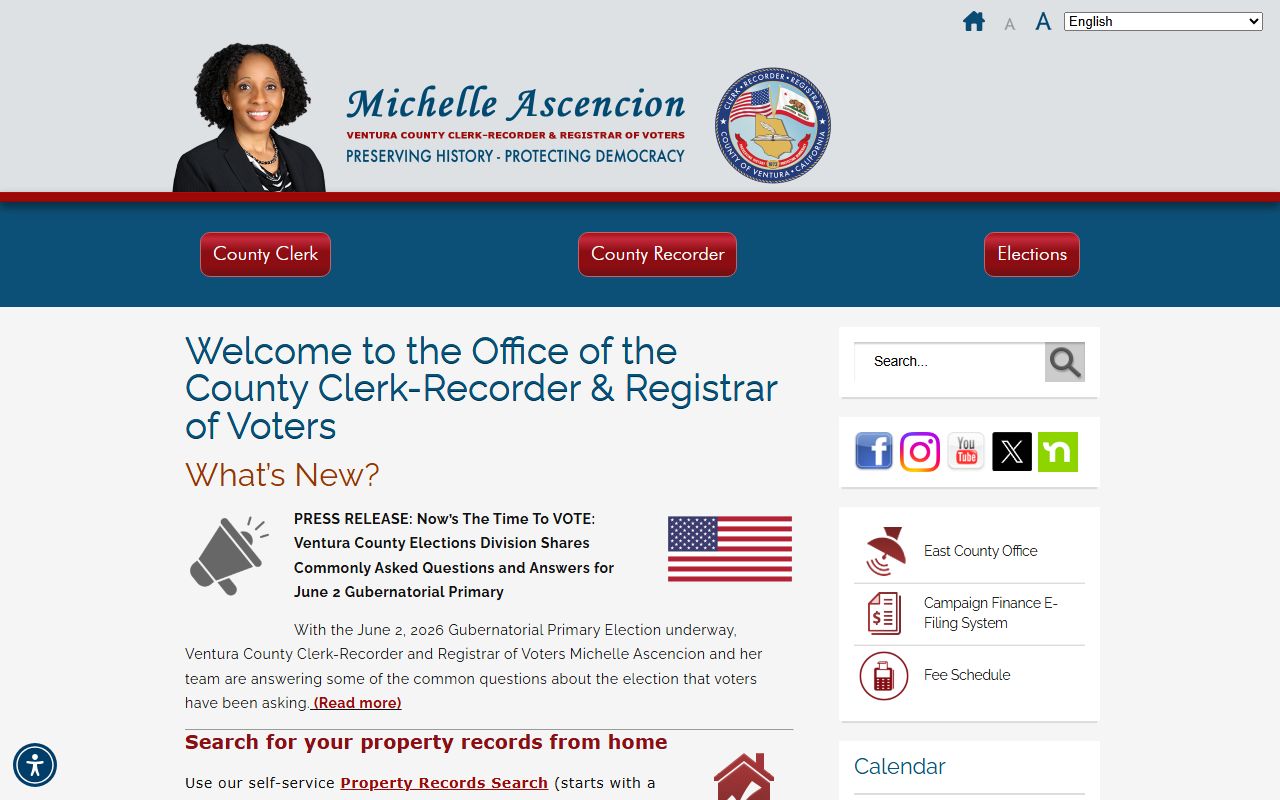
The Clerk-Recorder page lists vital records, marriage license info, and official record search tools. Users who want a marriage certificate or a deed copy go to the Clerk-Recorder, not the court clerk.
Superior Court Clerk vs County Clerk-Recorder
The two offices share the word clerk, but they hold different records. Sending a request to the wrong one wastes time and may cost a fee that does not get refunded.
| Record or Service | Clerk of the Superior Court | Ventura County Clerk-Recorder |
|---|---|---|
| Civil and family case files | Yes | No |
| Criminal and traffic case files | Yes | No |
| Probate and conservatorship files | Yes | No |
| Court judgments and abstracts | Yes | No |
| Marriage license and ceremony | No | Yes |
| Birth, death, marriage certificates | No | Yes (per vital records) |
| Deeds and recorded real-estate docs | No | Yes (per recorder online services) |
| Fictitious business name filings | No | Yes |
| Notary oaths and bonds | No | Yes |
Rule of thumb: if a judge heard the case, the file is at the court clerk. If a document was recorded against a property, a vital event, or a business name, the file is at the Clerk-Recorder.
How to Request a Certified Copy
A certified copy is a court-stamped copy of a filed document. Courts, lenders, schools, and federal agencies often want the certified copy, not a plain print from a portal. The Ventura court clerk can certify any document in the court file when the case is not sealed. The steps below are the standard route at the Hall of Justice.
- Find the case number through the case inquiry page.
- Identify the exact document by title, filing date, and page count.
- Fill out a request slip at the clerk's counter or use the form on the court's forms page.
- Pay the per-page copy fee and certification fee at the cashier window.
- Wait for the clerk to pull the file from imaged storage or paper. Same-day service is common for short documents.
- Pick up the stamped copy in person, or ask for mail return with a self-addressed envelope.
- Check the certification stamp and signature before leaving the counter.
Note: Sealed cases, juvenile files, and certain family records cannot be certified to a non-party without a court order signed by a judge.
Records Request Form Fields
The clerk's records request slip captures the same core fields whether the request is made at the counter or by mail. Filling each field before the visit cuts the wait at the window.
| Field | Required | Notes |
|---|---|---|
| Requester name and contact | Yes | Daytime phone or email. |
| Party name on the case | Yes | Full legal name as filed. |
| Case number | Yes | Pull from the case inquiry page. |
| Year of filing | Yes | Older files may sit in archive. |
| Document title or filing date | Yes | Helps locate the exact paper. |
| Copy type | Yes | Plain or certified. |
| Number of pages or copies | Yes | Estimate from the docket entry. |
| Certification requested | Yes/No | Per-document fee applies. |
| Delivery method | Yes | Counter pickup or mail return. |
| Payment | Yes | Cash, check, or card per cashier rules. |
A photo ID is often asked for at the counter for sealed or restricted cases.
In Person, Mail, and Online Requests
The Hall of Justice counter is the fastest route for a Ventura court records request, since same-day pickup is possible for many short documents. Public counters keep court hours posted on the main court site. Mail requests are slower but work well for out-of-county requesters. A written request with the case number, document title, copy type, and payment can be mailed to the clerk at 800 South Victoria Avenue, Ventura, CA 93009. Include a self-addressed stamped envelope.
Online portals allow free viewing of docket entries and many civil filings. Imaged documents are limited by California Rule of Court 2.503, so many family, juvenile, and confidential filings will not be visible online. The only route to those files is a written or in-person request to the clerk.

The Government Center campus holds the Hall of Justice and the Clerk-Recorder office on the same site, so both can be visited in one trip.
Ventura County Court Clerk Fees
Court copy and filing fees in Ventura are set by the current Superior Court fee schedule, posted on the court's fees page. Statewide filing fees follow the Judicial Council schedule, and local clerk fees follow the court's posted list. Users should pull the current schedule before any visit so the cashier window does not turn the request away for short payment.
| Item | Amount |
|---|---|
| Plain copy, per page | Set by current Superior Court fee schedule |
| Certified copy, per page | Set by current Superior Court fee schedule |
| Certification fee, per document | Set by current Superior Court fee schedule |
| Search fee for files past a fixed age | Set by current Superior Court fee schedule |
| Civil filing fee (unlimited) | Set by statewide Judicial Council schedule |
| Civil filing fee (limited) | Set by statewide Judicial Council schedule |
| Family law petition filing fee | Set by statewide Judicial Council schedule |
| Abstract of judgment | Set by current Superior Court fee schedule |
| Exemplification | Set by current Superior Court fee schedule |
Fee waivers are available for users who cannot afford court fees. The California self-help fee waiver page walks through eligibility and the FW-001 form.
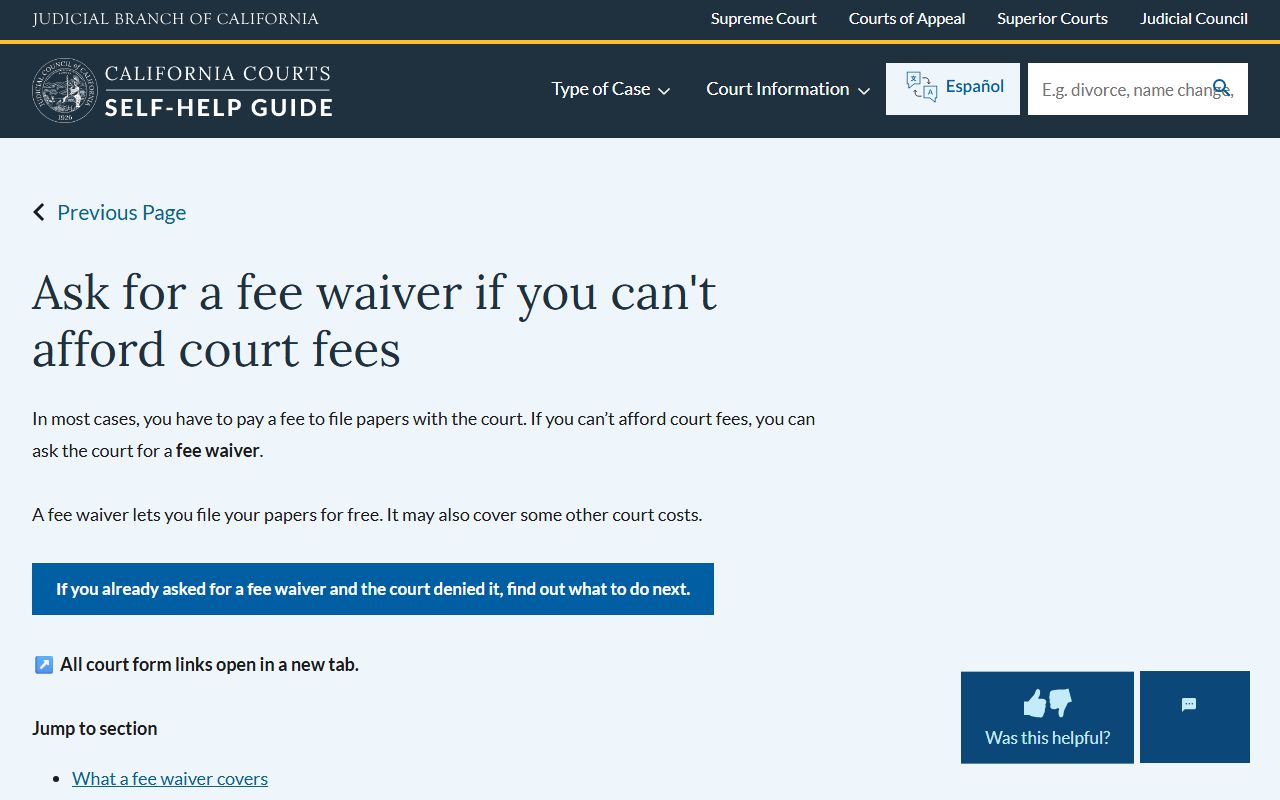
An approved fee waiver covers filing fees, copy fees, and some certification fees on the same case. It does not apply to non-court records held by the Clerk-Recorder.
Certified vs Informational Copies
A certified court copy is a true copy of a filed document, stamped by the clerk and signed under the court's seal. Outside agencies use it as proof the paper came from the court file. A plain copy is fine for a personal file, but it usually will not be accepted at a passport office, a federal benefit office, or a court in another state.
Vital record copies use a similar split, but the rules are run by the Clerk-Recorder, not the court. An authorized certified copy of a birth, death, or marriage record is limited to eligible requesters. An informational copy is available more broadly but carries a legend that blocks identity use. Court certified copies are not the same as vital record certified copies.
Q: Will the court clerk certify a deed or a marriage certificate?
A: No. Deeds and marriage certificates are not court records. The Ventura County Clerk-Recorder issues certified copies of recorded deeds and certified vital record copies. A request for either at the court clerk's window will be sent to the Clerk-Recorder.
Sealed and Confidential Court Records
Not every Ventura court file is public. Juvenile dependency and delinquency files are confidential by law. Sealed records, certain mental health files, and adoption files are not open to the public. Some family law files have confidential addresses and protected custody evaluations. The clerk will not release a sealed or confidential file without a court order.
A party to a sealed case can ask the clerk for a copy of papers from that party's own case. A non-party who needs a sealed file must file a motion to unseal with the assigned department and serve the request on the parties. The local rules govern how to ask for access, and the court's self-help center can help a self-represented requester find the right form.
Q: Can the court clerk seal a record on the spot?
A: No. Only a judge can order a record sealed. The clerk can accept the motion, calendar it for hearing, and apply the seal after the judge signs the order. Until then, the file stays open to the public unless a different state law makes it confidential on its own.
Forms and Filing With the Court Clerk
Most court filings in Ventura use statewide Judicial Council forms. The court's forms and filing page lists the local forms used in family law, probate, civil, and small claims matters. New filings can be brought to the clerk's counter, mailed in, or filed through eFiling where allowed. Each filing must include the right form, the right copies, the proof of service if needed, and the filing fee or a fee waiver.
Local rules add a few Ventura-specific steps. A probate petition needs the right notice schedule. A family law petition needs a summons and a UCCJEA declaration if minor children are involved. The local rules page lists the rules by case type. The clerk's staff cannot give legal advice but can answer process questions at the counter.
Common Errors That Slow Down a Request
A short list of mistakes accounts for most of the delays at the Ventura court clerk's window.
- Asking the court clerk for a marriage certificate or a deed; both are Clerk-Recorder records.
- Bringing the wrong case number; civil and criminal use different formats.
- Asking for a sealed or juvenile file without a court order.
- Short payment because the current fee schedule was not checked.
- Missing a self-addressed stamped envelope on a mail request.
- Asking for an "all documents" copy when only one or two are needed.
- Confusing a court certified copy with a vital record certified copy.
Note: A clean request slip with the case number, the document title, the year, and the copy type prevents almost every problem on the list above.